There is no built-in heating system in my Australian-standard un-insulated apartment, and the plug-in electric radiators do not have enough power to raise the temperature by a degree. In the past two winters, I used the gas stove as a heater. It is generally unwise to heat an enclosed space without purpose-built ventilation (such as a chimney) by burning something, because of the risk of CO poisoning. Even before CO becomes a problem, suffocation may occur because the CO2 concentration rises and oxygen concentration falls. Therefore, before deciding to heat with a gas stove, I looked up the research, made thorough calculations and checked them several times. I also bought a CO detector, tested it and placed it next to the gas stove. The ceiling has a smoke alarm permanently attached, but this only detects soot in the air, not gases like CO.
For the calculations, I looked up how much heat is produced by burning a cubic metre or kilogram of CH4 (natural gas), how much the temperature of the air in the apartment should rise as a result, how much CO2 the burning produces, and what the safe limits of long-term CO2 exposure are.
The energy content of CH4 is 37.2 MJ/m3, equivalently 50-55.5 MJ/kg. A pilot light of a water heater is estimated to produce 5.3 kWh/day = 20 MJ/day of heat, but a gas stove’s biggest burner turned fully on is estimated to produce 5-15 MJ/h, depending on the stove and the data source.
The chemical reaction of burning natural gas when oxygen is not a limiting factor is CH4 +2*O2 =CO2 +2*H2O. The molar masses of these gases are CH4=16 g/mol, O2=32 g/mol, CO2=44 g/mol, H2O=18 g/mol, air 29 g/mol. One stove burner on full for 1 hour uses about 0.182 kg =0.255 m3 of CH4 and 0.364 kg of O2, which depletes 1.82 kg = 1.52 m3 of air. The burning produces 2.75*0.182 = 0.5 kg = 0.41 m3 of CO2. The CO2 is denser than air, which is why it may remain in the apartment and displace air when the cracks around the windows are relatively high up. On the other hand, the CO2 also mixes with the air, so may escape at the same rate. Or alternatively, the CO2 is hot, so may rise and escape faster than air. For safety calculations, I want to use a conservative estimate, so assume that the CO2 remains in the apartment.
The volume of the apartment is 6x5x2.5 m =75 m^3. The density of air at room temperature is 1.2 kg/m^3, thus the mass of air in the apartment is 90 kg. The specific heat of air is 1005 kJ/(kg*K) at 20C. The walls and ceiling leak heat, thus more energy is actually needed to heat the apartment by a given amount than the calculation using only air shows. It takes 900 kJ of heat to raise the temperature of the air, not the walls, by 10C (from 12C to 22C). This requires 9/555 kg = 9/(16*555) kmol of CH4 with estimated energy density 55500 kJ/kg. Burning that CH4 also takes 9/(8*555) kmol of O2 and produces 9*11/(4*555) kmol = 9/200 kg of CO2.
The normal concentration of CO2 in outside air is 350-450 ppm. Estimate the baseline concentration in inside air to be 1/2000 ppm because of breathing and poor ventilation. Adding 1/2000 ppm from heating, the CO2 concentration reaches 1/1000 ppm. This is below the legal limit for long-term exposure.
CO is produced in low-oxygen burning. As long as the CO2 concentration in the air is low and the oxygen concentration high, the risk of CO poisoning is small.
For the actual heating, I first tested running the smallest burner all day while I was at home, and paid attention to whether I felt sleepy and whether the air in the apartment smelled more stale than outside or in the corridor. There seemed to be no problems. For nighttime heating, I started with the smallest burner in the lowest setting, similarly paying attention to whether the air in the morning smelled staler than usual and whether I felt any different. Because there were no problems, I gradually increased the heating from week to week. The maximum I reached was to turn on the largest burner to less than half power, and one or two smaller burners fully. Together, these burners produced much less heat than the largest burner on full, as could be easily checked by feel when standing next to the stove. At night, the stove prevented the temperature in the apartment from dropping by the usual 2C, but did not increase it. The CO2 produced was probably far less than the bound I calculated above by assuming a 10C increase in temperature. Empirically, I’m still alive after two winters of letting the gas stove run overnight.
Charge electric cars fast by changing the battery
An electric car drives into a charging station. The driver pushes a button to unlock the battery compartment hatch on the rear bumper. The hatch springs open, which is detected by a camera of the station. A robotic arm swings into motion and, guided by cameras, radar or ultrasound, latches on to well-marked standardised handles on the rear of the battery. The arm pulls out the 300kg, 1×2 metre battery from underneath the floor of the car and slides it onto a conveyor belt. The belt moves the battery to one side and brings up a new battery, which the robotic arm picks up and slides back into the car’s battery compartment. The driver pushes a button to close and lock the battery compartment and drives off. The whole charging process takes less than a minute – significantly faster than filling up a gasoline-powered car.
Due to the weight and size of an electric car’s battery, a robotic arm is probably necessary. It is also faster and more precise than a human.
The usage history of the battery should be recorded securely, in order to make users pay for its depreciation, not just the electricity they used. Blockchain may be useful for keeping track of usage, which is needed to deter the moral hazard of using the battery inappropriately and not paying for the damage, or swapping it for a cheaper alternative before having it changed back to a standard one in a charging station.
The compartment in which the battery is has to be water-tight and locked (like the trunk or hood of a car) to prevent theft. The compartment should also be unlockable remotely by the owner or other authorised person, in case the car is self-driving and has no humans in it.
Improvement for noise-cancelling headphones
Current noise-cancelling headphones deal well with predictable noise that has a short period of repetition, for example engine rumbling or the hum of an air-conditioner or fan. Unpredictable noise is of course difficult to cancel – the headphones would have to detect the new sound and produce the opposite wave of air pressure quicker than the human ear can detect the new sound. This is theoretically possible, because the sound reaches the outside of the headphone before it reaches the inside of the ear, but may not be feasible at the current technology level.
What is possible, but not done, at least by the Sony MDR-1000x headphones I have, is cancelling predictable noise with a longer period of repetition. Specifically, the beeping sound of trucks reversing has a period of 1-2s and is very predictable, but the headphones do not cancel it at all. It seems that a tweak of the noise-prediction algorithm could fix this – no need to invoke machine learning or anything more complicated. The headphones would just have to keep track of the sounds reaching them in the last few seconds and look for simple repeating patterns. Then these patterns can be predicted and cancelled. Currently the headphones seem to predict only based on the last half-second or less, so any longer repetitions of sound are not taken into account.
Some birdsong is repeated beeping, similar to the signal of trucks reversing, but of course slightly less predictable. This bird-noise could conceivably also be cancelled, although if the gaps between the beeps vary, then the first small length of time during an unexpectedly early beep would be difficult. Similarly, if the length of the beeps varies, then a beep that stops unexpectedly early would be over-cancelled (headphones produce a sound that is detectable on the background of silence).
To help the headphones recognise new noise patterns, the user can press a button when an undesirable sound is heard, and release the button when the sound stops. The algorithm can compare the button presses to its sound-recording in the same time interval, which would help it identify the start and end of the noise that needs to be cancelled. Sometimes humans are better at detecting complex patterns than a computer, in which case this user input to the headphones would speed up the identification of new forms of noise.
Online reviews should include more facts
Online reviews are a public good and increase social welfare, but they could be improved by including more concrete data. For example, a restaurant or grocery store review should list the prices of specific foods. A review of a bar or function venue could estimate the number of tables and seats and the distance between tables, thus quantifying how cramped the room is. Currently, most reviews on Google Maps, Yelp and other similar sites are vague, just stating that the reviewer had a bad or great experience, that the staff were helpful or not, etc.
The purpose of a review is (hopefully) to help others (although some people just write rants to vent their emotions). Facts in reviews would help others more than opinions. Photos of the establishment and the food are useful, because they provide factual information. Some photos are more helpful than others. For example, it is more useful to see the inside than the outside of a venue. It is not very useful to see a picture of the outdoor sign of the establishment, but a readable photo of the menu conveys lots of information. In the future, Google Maps and competitors could automatically extract text from photos that contain it, and display the information in search results. Then photos of the menu, or of prices in a grocery store would be even more useful.
The idea for this post came from fruitlessly searching the web for current prices of groceries in different supermarkets in town. It would have been helpful if recent reviews of these supermarkets had included prices of at least some items.
The grocery price comparison apps that I tried had the limitation that the prices were for specific branded products and per package (e.g. Organic Carrots 500g), not per kilogram of a generic product (e.g. 1kg of carrots). This made it difficult to compare general pricing across shops, because each shop has a different range of brands, and only the price of the exact same brand can be compared.
An easy fix to improve the apps would be to allow users to specify which differently-branded products should be treated as identical, for example “Coles orange juice 2 litres” is the same for me as “Woolworths orange juice 2 litres”. Merging similar products would also reduce the memory requirement of the app, because the product database would have fewer entries to keep track of.
Checklist for fixing up a used bicycle
The following checklist, inspired by Cycle Jam at the Canberra Environment Centre, is to make a used bicycle safe and rideable. It is just a minimum; it does not optimise a bike.
Frame should not have cracks. Frame should not be bent.
Handlebar should not rotate in clamp.
Handlebar clamp should not rotate relative to front wheel.
Brake levers and shifters should not rotate on the handlebar.
Both brakes should be securely attached to the frame.
Brake levers should not hit the handlebar.
Brake pads should hit the rim when the brake is pulled, not the wheel or the spokes. Brake pads should be more than 1mm thick. Brake cables should slide reasonably in their housing.
Wheels should not be so bent that either the brakes rub or the brake levers hit the handlebar and prevent braking. Spokes should not be broken or loose.
Wheels should not clunk side to side on axle. Preferably wheel bearings should not grind either.
Wheels should be seated in the dropouts properly.
Quick releases of wheels should be closed properly.
Headset should not clunk, preferably not grind either.
Bottom bracket should not clunk side to side, preferably not grind either.
Crankarms and pedals should not clunk on their attachment point, ideally pedal bearings should not grind.
Seatpost clamp securely fastened, quick release closed properly. Seat securely attached to seatpost.
Chainring bolts should be tight.
Tires pumped, not too worn or cracked. Valve stem straight (pointing to the hub).
Suspension (if any) working reasonably.
Check shifting into all gears front and rear. If problems, then:
Front derailleur should be securely attached to the frame at the correct height, not bent or angled wrong.
Front derailleur limit screws should not allow the chain to come off.
Rear derailleur securely attached to frame, not too bent.
Shifter cables should slide reasonably in their housing.
Chain should be neither too worn nor too long (sagging, too many links).
Poaching reduction using lab-grown ivory
Poachers kill elephants for tusks and rhinos for horns because these can be sold for a high price on the black market. The killing has occurred both in the wild and in zoos, and thieves have broken into nature museums to steal rhino horns from exhibits. Sometimes news reports describe how police crush or burn seized illegal ivory, which seems counterproductive, because it reduces supply and thus drives up the price. A higher price increases future poaching. Perhaps the police are in the pay of some illegal ivory dealers and are deliberately helping drive up the price by destroying competing dealers’ products.
Instead, the price of ivory and rhino horn should be reduced so that poaching becomes unprofitable. Many organs have been grown in the lab using a collagen scaffold seeded with stem cells from the appropriate tissue (bladder, skin, heart). Growing elephant tusks or rhino horns in the lab should be feasible using similar techniques. Flooding the market with cheap lab-grown horns and tusks would eliminate the incentive to poach.
The demand for ivory and rhino horn is mostly due to silly beliefs about their medicinal properties, so the buyers may not want lab-grown substitutes, believing these to be ineffectual (which these are, just like wild-type horns and tusks). In this case, the lab-grown horns and tusks should be made indistinguishable from animal-derived ones and inserted into the illegal supply chain covertly. The dealers on the black market are not too honest people and would probably be happy to lie to their customers that lab-grown products are from wild animals.
Reducing reflections off eyeglasses
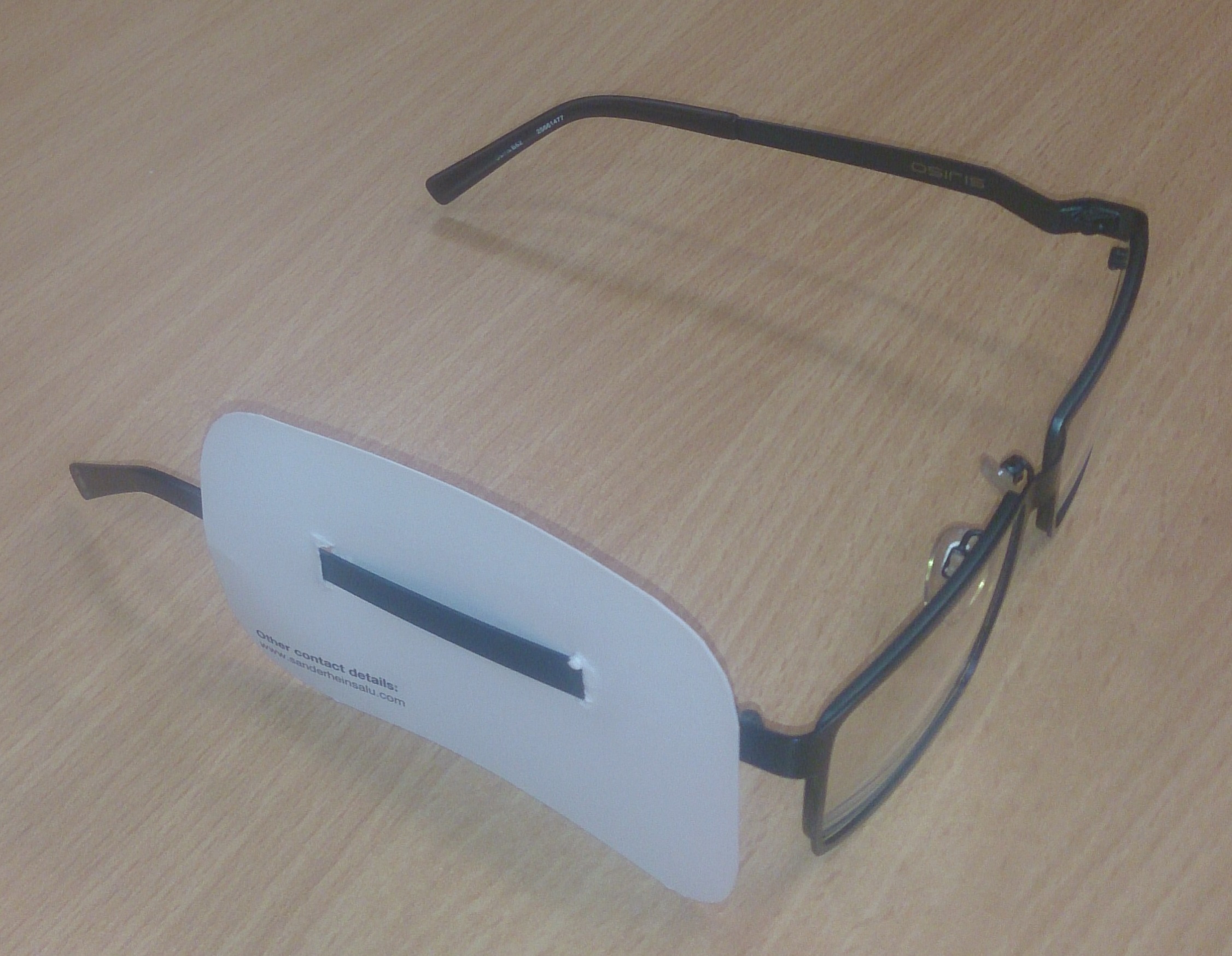
Spectacle shops try to sell customers more expensive lenses with glare-reducing coatings. Such coatings are often fragile, which benefits the sellers, because the glare-reducing lenses would need frequent replacement. Another way to reduce glare reflecting into the eye is to find its source and block it. For example, standard flat-lens eyeglasses reflect rays coming from behind and slightly to the side into the eye. If the light source behind can be eliminated, e.g. curtains drawn across a window, then the glare disappears.
There may be many sources of light that reflect from the glasses into the eye, for example due to multiple head orientations and light sources all around. In that case, blocking the light at the source is infeasible, but the rays causing glare can still be blocked closer to the eye. One way is to put side panels on the earpieces of the glasses. The side panel must touch the head with the edge closer to one’s back, so rays from behind cannot get between the earpiece and the head, so cannot reflect off the lens into the eye. The side panels can be cut from cardboard and slipped on the earpieces, as shown in the photo below.
The side panels will also block unwanted light coming from one side into one eye directly (without reflecting off the lens). An example is the Sun shining through a window to the side, causing eye strain.
Self-balancing computer game
In both tabletop role-playing and computer games where players choose between different characters, some characters may be stronger than others when played optimally. This is undesirable in multiplayer games, because either most players will choose the stronger characters or some players will be handicapped by their weak character, which tends to reduce the enjoyment. Game designers spend time and resources “balancing” the game, i.e. changing aspects of the characters to give them all approximately equal strength. It is difficult to predict all possible ways a character may be played, so players may discover tricks that make a character significantly stronger than others. To counteract this, the game can be made self-balancing: the more players choose a given character, the weaker that character becomes. Then the discovery of ways to play a character better (giving additional strength) initially benefits the discoverer, but is neutralised with widespread imitation, analogously to innovative firms reaping monopoly profits initially from their patents, but eventually losing their competitive advantage to imitators.
The simplest way to self-balance is to subtract some measure of strength, e.g. health points, armor, attack points from the most frequently chosen characters. One in-game interpretation of this loss of strength to crowding is that each character channels power from some source (magic item, god, nature) and if more people channel a given source, then each of them gets less power. There are other ways to impose a negative congestion externality to achieve self-balancing.
One source of congestion-induced weakening is that in-game enemies (NPCs) fight better against characters they frequently encounter. This can be interpreted as learning (if the enemies flee before dying and later come back) or evolution (if the longer-surviving enemies multiply relatively more). In an evolutionary arms race, players pick characters that are strong against frequently encountered NPCs. NPCs vary in their resistance to different attacks and relatively more copies are spawned of those who last the longest under player attack.
Another congestion externality is a shortage of some resource that strengthens a particular class of characters. For example, equipment usable by that class may be in limited supply, in which case if many players choose that class, then they will find themselves under-equipped and weak. There could also be a shortage of materials for manufacturing the equipment, or a shortage of class-specific quests for gaining experience.
To make players (as opposed to NPCs or the game mechanics) the source of disadvantage to a frequently chosen class, the classes should have advantages over each other in a cycle, for example archers defeat riders, riders defeat swordfighters, swords defeat archers. In this case, if a class is frequently chosen, then this invites other players to choose another class that has an advantage over the frequent class, e.g. if many have chosen riders, then this creates an incentive to choose archers. Such a cyclical evolutionary dynamic has been observed in lizards (Rapid Temporal Reversal in Predator-Driven Natural Selection, Science 17 Nov 2006 Vol. 314, Issue 5802, pp. 1111).
“What if” is a manipulative question
“What if this bad event happens?” is a question used as a high-pressure sales tactic (for insurance, maintenance, upgrades and various protective measures). People suffering from anxiety or depression also tend to ask that question, which is called catastrophising. The question generates vague fears and is usually unhelpful for finding reasonable preventive or corrective measures for the bad event. Fearful people tend to jump on anything that looks like it might be a prevention or cure, which sometimes makes the problem worse (e.g. quack remedies for imagined rare disease worsen health).
A more useful question is: “What is the probability of this bad event happening?” This question directs attention to statistics and research about the event. Often, the fear-generating event is so unlikely that it is not worth worrying about. Even if it has significant probability, checking the research on it is more likely to lead to solutions than vague rumination along the lines of “what if.” Even if there are no solutions, statistics about the bad event often suggest circumstances that make it more likely, thus information on which situations or risk factors to avoid.
These points have been made before, as exemplified by the aphorisms “Prepare for what is likely and you are likely to be prepared” and “Safety is an expensive illusion.”
News are gradually biased by re-reporting
The (science) news cycle occurs when the original source is quoted by another news outlet, which is quoted by another outlet, etc, creating a “telephone game”, a.k.a. “Chinese whispers” familiar from kindergarten. Each re-reporting introduces noise to the previous report, so the end result may differ diametrically from the original story. This news cycle has been identified and mocked before, e.g. by PhD Comics.
The telephone game of news outlets has an additional aspect that I have not seen mentioned, namely that the re-reporting does not add random noise, but noise that biases the previous source deliberately. Each news outlet, blog or other re-poster has a slant and focusses on those aspects of the story that favour its existing viewpoint.
A single outlet usually does not change the story to the complete opposite of the original, because outright lying is easy to detect and would damage the outlet’s reputation. However, many outlets in a sequence can each bias the story a little, until the final report is the opposite of the original. Each outlet’s biasing decision is difficult to detect, because the small bias is hidden in the noise of rephrasing and selectively copying the previous outlet’s story. So each outlet can claim to report unbiased news, if readers do not question why the outlet used second-hand (really n-th hand) sources, not the original article (the first in the sequence). A single manipulator thus has an incentive to create many websites that report each other’s stories in a sequence.
The moral of this text is that to get accurate information, read the original source. Whenever you see an interesting news article, work backward along the sequence of reports to see whether the claims are the same as in the first report. The first report is not guaranteed to be true, but at least the biases and honest errors introduced later can be removed this way.